
Pyrolysis, Plastics, and Public Health

Updated: Feb 18
For a more consolidated presentation of this information to share with concerned stakeholders, check out this fact sheet, which is free to use and distribute.
According to a 2017 analysis, half of all the plastic ever produced was created between 2000 and 2015. Further analysis indicates that this number is likely an underestimation, and plastic production has continued to grow in the meantime, outpacing the rate of effective waste management. While plastic recycling programs exist in the United States, only around 5% of plastics are successfully recycled, meaning that most discarded plastic ends up in landfills, incinerators, and waterways.

Plastic manufacturers, petrochemical producers, and the oil and gas industry recently began advertising a new type of plastic waste processing called “chemical recycling” or “advanced recycling.” These catch-all terms include various methods that are purported to recapture plastic waste, but they do not accurately describe a closed-loop system that produces new plastic from waste plastic at scale. Among these processes, the most common is pyrolysis, which is used in about 80% of currently operating and proposed plastic waste facilities to break down long-chain polymers into smaller hydrocarbons.
Pyrolysis generally refers to the process of superheating material in a sealed chamber without oxygen. Plastic pyrolysis facilities feed shredded or pelletized waste into a reactor as feedstock and heat it to between 570 and 1290 °F (300 and 700 °C). Traditional incinerators rely on the presence of air for combustion, which creates byproducts, such as ash and smoke. For this reason, some supporters of plastic pyrolysis claim it creates less pollution than conventional incineration and results in products that can be refined into fuels or plastic precursors. However, the pyrolysis process requires substantial energy input and creates gases that are toxic to human health.
Pollution Hazards
Pyrolysis produces a range of hazardous gases and chemicals that are harmful to human health and the environment, including well-known compounds typically found among industrial emissions, as well as lesser-known but potent pollutants that may cause a wide array of health effects, as detailed in the table below. Many pollutants released during the process depend on the components of the plastic waste fed into the system.
Pollutant | Pyrolysis Stage | Where Pollutant Appears |
Feedstock handling and shredding into pellets | Dust is generated from the mechanical breakdown of plastics ahead of processing.
| |
Volatile Organic Compounds (VOCs) [Methane, ethane, aldehydes, acids✝] | Pyrolysis Reaction & Condensation | High levels produced during heating and gas phase, notable during exhaust and cooling phases. |
Startup/Shutdown, Combustion of By-product Gases | Generated when leftover gases are burned to fuel the reactor. Common when system is running improperly or switching operating modes. | |
Hydrogen Sulfide (H₂S) | Pyrolysis Reaction | Produced primarily when sulfur-containing feedstocks break down. |
Polycyclic Aromatic Hydrocarbons (PAHs) [naphthalene, fluorene, phenanthrene] | Pyrolysis Reaction & Condensation | Formed as part of pyrolysis vapors, most frequently in gas and residue streams. |
Faulty Operation | Most common in malfunction or improper operation. | |
Polychlorinated Biphenyls (PCBs) | Pyrolysis Reaction (if present in original feedstock) | Released if PCBs are present in feedstock, which is common. |
✝ VOCs produced depends highly on feedstock components. For example, PVC pyrolysis will contain higher levels of vinyl chloride, a potent VOC.
Explosion and Gas Leak Hazards
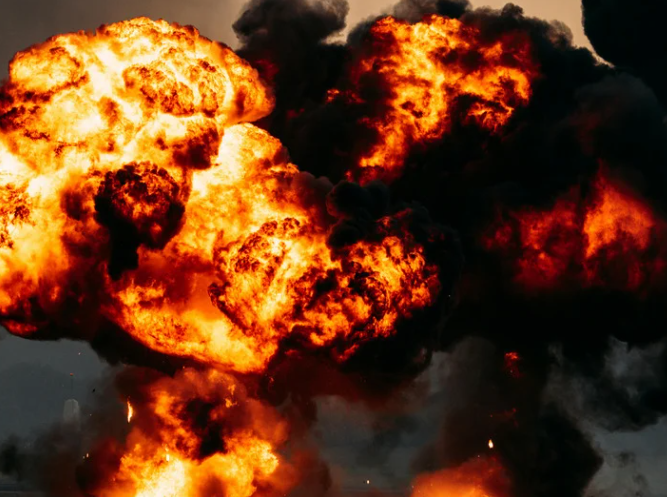
Pyrolysis facilities raise concerns about safety in part due to the potential for explosions and leaks. Because pyrolysis operations require such high temperatures, the risk of explosion is higher if oxygen is unintentionally introduced into the system. Multiple incidents of pyrolysis facility malfunctions have been documented, including fatal explosions in Denmark and accidents in India, China, Russia, Germany, and Finland. In India and China in 2017 and 2018, respectively, gas leaks led to fires, explosions, and exposure to hazardous air pollutants for thousands of people and workers in the area.
Part of the risk is that leftover fuel from the pyrolysis process can create a highly flammable synthesis gas, also called “syngas.” Syngas can accumulate in the reactor and piping, especially during startup or shutdown of the facility. Inert gases, such as nitrogen, are used to flush out syngas, but introducing nitrogen to the system creates additional airborne health risks, particularly for workers. For example, airborne nitrogen tends to replace breathable air in the vicinity, leading to dizziness, rapid unconsciousness, or death by asphyxiation in larger quantities. Beyond the pyrolysis facilities themselves, gas leaks can occur along any pipeline at any time. The risk of leaks is high because pipelines require enormous pressure to push gases to their destination, and many of them are not regularly checked for leaks. With the addition of pyrolysis facilities into an aging network of pipeline infrastructure, increased strain on the system will likely lead to more accidents that can result in pollutant exposure and death.
Transport of Hazardous Waste
Pyrolysis produces hazardous waste, some of which may be transported across state lines and through multiple jurisdictions that may classify and handle the waste differently. According to a National Resources Defense Council (NRDC) report on pyrolysis facilities, just three facilities in the United States produced over 2 million pounds of hazardous waste between 2021 and 2024. In each case, these facilities required transport of hazardous waste away from the site for disposal. Recent train derailments, such as the one in East Palestine, OH in 2023, shed light on the extreme risks of moving dangerous substances along transportation networks. Moving these hazardous substances expands the health risks beyond the vicinity of the pyrolysis facilities to include communities and environments along those transportation corridors.

Ongoing Environmental Justice Concerns
A 2023 Beyond Plastics report found that of the 11 “chemical recycling” plants in the US at the time, seven of them were in environmental justice communities. Communities with this designation often bear disproportionate exposure burdens, with risks coming from fenceline exposures near facilities, waste transportation between facilities, or both. Of the seven “chemical recycling” facilities located in vulnerable communities in this report, six use pyrolysis.
What You Can Do
Register your concerns about the health and environmental impacts of pyrolysis and so-called “chemical recycling” facilities with your elected representatives. You can find out how to contact your local, state, and federal representatives here.
Encourage local businesses and networks to reduce their reliance on single-use plastics and recycling infrastructure, rather than investing in “chemical recycling” facilities.
If your community has a proposed pyrolysis facility:
Find and attend local ordinance meetings about the introduction of the facility and voice your concerns. Most of these decisions are made at the local level, not at the state or federal level.
Push for strict permitting, continuous emissions monitoring, and public hearings before the facilities are approved. Additionally, demand the facilities track and share information about hazardous waste generation, as well as transport methods and routes.
Demand permitting transparency and visibility regarding the types of plastics (e.g., polyethylene, polypropylene, polystyrene) that will be pyrolyzed and what expected chemical emissions will come from the facility. Site-specific information will be more helpful in forming a directed response to the planned facility. If possible, connect with nearby organizations that may be able to help you understand local impacts and avenues for action.
Advocate for community air monitoring, especially around proposed pyrolysis facilities and existing sites, ideally before they begin operation.
Consult Environmental Health Project’s AirView Public Tool, a community pollution analysis app. If there are air quality monitors in your area, information here can help you understand the air quality nearby to better protect yourself from pollution risks.

If your community already has a pyrolysis facility:
Use permitting and Right-to-Know processes to request timely reports about the hazardous waste generated, handled, and transported offsite.
If you want to learn more about possible connections between chemical exposures and health symptoms, such as skin rashes, headaches, and fatigue, explore EHP’s Compounds of Concern tool, which details many health impacts of specific compounds that may be emitted from pipeline leaks. Alternatively, you can search by chemical compound if you learn what pollutants are among the emissions at your nearby pyrolysis facilities.
Document and report your health symptoms, especially respiratory or neurologic signs, by using a health journal and consulting your doctor. For additional healthcare resources, you can contact your local health department or a nearby HRSA-funded facility.
Keep in mind that many health risks are significant for facility workers. Advocate for facility workers to be provided with respiratory protection, especially during startup, shutdown, or maintenance phases of pyrolysis.
Advocate for more strict engineering controls on facilities, such as gas scrubbers, inert-gas purging, and continuous leak-detection systems to ensure safety for workers and nearby communities
The table below highlights common air pollution and physical health risks associated with exposure to the activities around pyrolysis facilities:
Health Risks Table
Exposure/Incident Type | Affected Group | Short-Term Effects | Long-Term Risks |
VOCs, PM, CO, NOx, SOx | Nearby residents, workers | Irritation, headache, nausea, fatigue | Cancer, respiratory disease, cardiovascular disease, neurological damage |
Dioxins | Nearby residents, workers | Skin lesions, liver effects | Cancer, developmental problems, effects on endocrine system |
Explosion / Fire | Workers, nearby populations | Burns, trauma, immediate fatalities | Physical injuries, Post-Traumatic Stress Disorder (PTSD) |
Hazardous waste & spill exposure | Transportation corridor communities | Skin irritation, ingestion risk | Chronic disease from persistent pollutants on several organ systems |
Transportation accidents | Communities along routes | Acute chemical exposure | Long-term environmental contamination |
References
American Chemistry Council. (2017). Comparison of plastics-to-fuel and petrochemistry manufacturing emissions to common manufacturing emissions. https://mde.maryland.gov/programs/LAND/SolidWaste/Documents/HB124%20Documents/Final_PTFP_Emissions_07172017_v2.pdf
Beyond Plastics. (2023). Chemical recycling: a dangerous deception. https://www.beyondplastics.org/fact-sheets/chemical-recycling
Gribkoff, E. (2022). Chemical recycling grows—along with its environmental impacts. Environmental Health Network. https://www.ehn.org/chemical-recycling
Sharp, R., & Goff, S. (2025). “Chemical recycling” is a toxic trap. Natural Resources Defense Council. https://www.nrdc.org/resources/chemical-recycling
Dai, L., Zhou, N., Lv, Y., Cheng, Y., Wang, Y., Liu, Y., Cobb, K., Chen, P., Lei, H., & Ruan, R. (2022). Pyrolysis technology for plastic waste recycling: A state-of-the-art review. Progress in Energy and Combustion Science, 93. https://doi.org/10.1016/j.pecs.2022.101021
Even, M., Girard, M., Rich, A., Hutzler, C., & Luch, A. (2019). Emissions of VOCs from polymer-based consumer products: from emission data of real samples to the assessment of inhalation exposure. Frontiers in Public Health, 7. https://doi.org/10.3389/fpubh.2019.00202
Hedlund, F. (2023). Inherent hazards and limited regulatory oversight in the waste plastic recycling sector: repeat explosion at pyrolysis plant. Chemical Engineering Transactions, 99, 241–246. https://doi.org/10.3303/CET2399041
Khan, M. Z. H., Sultana, M., Al-Mamun, M. R., & Hasan, M. R. (2016). Pyrolytic waste plastic oil and its diesel blend: fuel characterization. Journal of Environmental and Public Health. https://doi.org/10.1155/2016/7869080
Paladino, O., & Moranda, A. (2021). Human Health Risk Assessment of a pilot-plant for catalytic pyrolysis of mixed waste plastics for fuel production. Journal of Hazardous Materials, 405. https://doi.org/10.1016/j.jhazmat.2020.124222
Sheriff, S. S., Yusuf, A. A., Akiyode, O. O., Hallie, E. F., Odoma, S., Yambasu, R. A., Thompson-Williams, K., Asumana, C., Gono, S. Z., & Kamara, M. A. (2025). A comprehensive review on exposure to toxins and health risks from plastic waste: Challenges, mitigation measures, and policy interventions. Waste Management Bulletin, 3(3). https://doi.org/10.1016/j.wmb.2025.100204


